
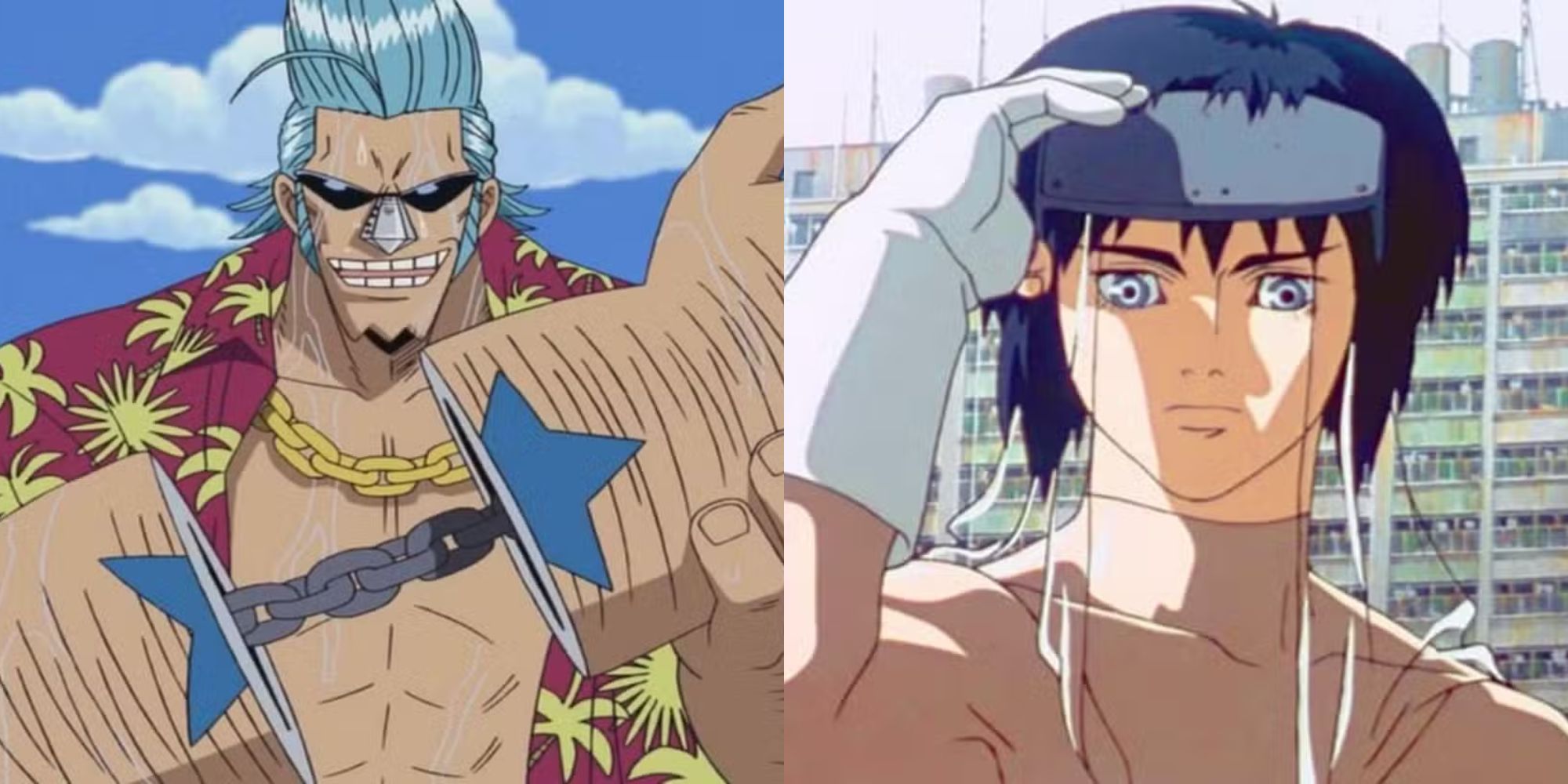
From war-torn battlefields to neon-lit cityscapes, anime has long explored the blurred line between man and machine. In stories where humanity is tested and technology redefines identity, few figures are as captivating, or as tragic, as the cyborg.
These characters aren’t just enhanced with mechanical limbs or advanced weaponry. They often carry the weight of what they lost in the process: their past, their purpose, or even their place in the world. Whether born of desperation, science, or sacrifice, each cyborg in anime reflects something deeply human beneath the metal.
Related
15 Best Isekai Anime With Mecha
Looking for a great isekai anime with mecha? Look no further.
As animation continues to evolve, so too does its portrayal of cybernetic life. These are the characters who didn’t just survive the transformation, they became unforgettable because of it.
9
Motoko Kusanagi
Ghost in the Shell


- Release Date
-
December 8, 1995
- Runtime
-
83 Minutes
- Director
-
Mizuho Nishikubo, Mamoru Oshii
Major Motoko Kusanagi stands as perhaps the most philosophically complex cyborg in anime history. Her body is entirely artificial, housing only her brain and spinal cord as remnants of her original human form. This full-body prosthetic grants her superhuman strength, speed, and the ability to interface directly with computer networks through cybernetic ports.
The Ghost in the Shell franchise, particularly the 1995 film and Stand Alone Complex series, uses Kusanagi to explore questions of identity and consciousness. Her cybernetic body can be damaged, destroyed, and replaced, yet she maintains her sense of self through what she calls her “ghost” – the intangible essence of her being.
Kusanagi’s transformation into a cyborg wasn’t by choice. As a child, she was severely injured in a plane crash, leaving her with no option but to receive a full-body prosthetic to survive. This origin shapes her constant questioning of what makes someone truly human.
8
Frank Archer
Fullmetal Alchemist: Brotherhood

Frank Archer’s transformation from human to cyborg in Fullmetal Alchemist represents one of the most disturbing character arcs in the series. Originally appearing as a high-ranking military officer obsessed with his own image and power, Archer’s vanity ultimately leads to his mechanical rebirth.
After suffering severe injuries that would have killed most people, Archer voluntarily undergoes extensive cybernetic reconstruction rather than accept death. His right arm becomes a mechanical appendage, and much of his torso is replaced with metal components that give him enhanced durability and strength.
The 2003 anime version of Fullmetal Alchemist portrays Archer’s cyborg transformation as a reflection of his twisted priorities. He values his position and influence more than his humanity, willingly sacrificing his organic body to maintain his grip on power.
His mechanical enhancements include a gun built into his prosthetic arm and reinforced skeletal components that allow him to survive impacts that would crush a normal human. However, these improvements come at the cost of his sanity, as Archer becomes increasingly unstable and violent following his reconstruction.
7
Android 18
Dragon Ball


- Release Date
-
1986 – 1989
- Directors
-
Minoru Okazaki, Daisuke Nishio
- Writers
-
Akira Toriyama
Android 18’s designation as an “android” is technically a mistranslation from the original Japanese “jinzōningen,” which means artificial human. She and her twin brother Android 17 are actually cyborgs, enhanced humans rather than purely mechanical beings created by Dr. Gero.
Originally human siblings named Lazuli and Lapis, they were kidnapped by Dr. Gero and subjected to extensive mechanical modifications. These enhancements grant them unlimited energy, superhuman strength that rivals the Saiyans, and the ability to fly. Unlike purely mechanical androids, they retain their human emotions and capacity for growth.
Her character development throughout Dragon Ball Z showcases how even artificially enhanced beings can experience genuine human connections. Her relationship with Krillin and their eventual marriage demonstrates that her mechanical components don’t diminish her capacity for love and family.
Android 18’s power level remains consistently high without the energy depletion that affects natural fighters. Her infinite energy model makes her a formidable opponent who never tires in battle, though she lacks the explosive power increases that Saiyans achieve through transformation.
6
Jet Black
Cowboy Bebop


Jet Black’s cybernetic arm serves as a constant reminder of his past life as an Inter Solar System Police officer. The mechanical limb, which he calls his “Sunday best,” replaced his original arm after it was severely damaged during his final case as a cop, an incident that also shattered his faith in the justice system.
His prosthetic arm provides enhanced strength and durability, but Jet rarely flaunts these capabilities. Instead, the arm represents his pragmatic approach to life’s challenges. When something breaks, you fix it and move on, whether it’s a ship’s engine or your own body.

Related
10 Best Cyberpunk Anime, Ranked
The anime industry has given us several Cyberpunk anime series, but these are surely some of the best and most unforgettable ones.
The backstory revealed in Cowboy Bebop shows that Jet lost his arm while investigating corruption within his own police force. His partner betrayed him, leading to the injury that ended his law enforcement career and set him on the path to becoming a bounty hunter.
Unlike flashier cyborgs, Jet’s mechanical enhancement is purely functional. He uses it for ship repairs, combat when necessary, and the various practical tasks required to keep the Bebop running. His approach to his cybernetic limb reflects his character, practical, understated, and focused on getting the job done.
5
Jeremiah Gottwald
Code Geass: Lelouch of the Rebellion R2

Jeremiah Gottwald’s transformation into a cyborg in Code Geass R2 represents one of the most dramatic character rehabilitations in anime. Originally introduced as a loyal Britannian soldier with an almost comical obsession with oranges, his cybernetic reconstruction turns him into a formidable ally for Lelouch.
His cyborg body grants him enhanced physical capabilities and, most importantly, immunity to Geass commands. This protection comes from specialized cybernetic implants that block the supernatural mind control abilities that dominate much of Code Geass’s power structure.
The process that created Cyborg Jeremiah involved extensive modification by the Geass Order, transforming him from a relatively minor antagonist into a key player in the series’ final acts. His mechanical components include enhanced reflexes and the ability to interface with Knightmare Frame technology more effectively.
His loyalty to Lelouch after his reconstruction stems from learning the truth about the events that originally disgraced him. The revelation that Lelouch’s actions actually protected his sister Nunnally transforms Jeremiah from enemy to devoted servant,
4
Gally
Alita Battle Angel


Gally, known as Alita in the English adaptations, embodies the cyberpunk ideal of humanity transcending physical limitations through technology. Found as a disembodied head and torso in the Scrapyard beneath the floating city of Zalem, she receives a new cyborg body that awakens memories of her past as a skilled martial artist.
Her Panzer Kunst fighting style, a cyborg-specific martial art designed for mechanical bodies, allows her to compete in the brutal sport of Motorball and take on opponents many times her size. The fighting technique emphasizes using a cyborg’s mechanical advantages while maintaining fluid, dance-like movements.
The original Battle Angel Alita manga and its anime adaptation explore themes of identity through Gally’s journey. She struggles to recover her memories while adapting to different mechanical bodies, each offering unique capabilities and limitations.
Her various body upgrades throughout the series include the Imaginos body, designed specifically for Motorball competition, and combat frames built for warfare. Each transformation forces her to readjust not just to new physical capabilities, but to how others perceive her based on her mechanical appearance.
3
Franky
One Piece


- Release Date
-
October 20, 1999
- Network
-
Fuji TV
- Directors
-
Hiroaki Miyamoto, Konosuke Uda, Junji Shimizu, Satoshi Itō, Munehisa Sakai, Katsumi Tokoro, Yutaka Nakajima, Yoshihiro Ueda, Kenichi Takeshita, Yoko Ikeda, Ryota Nakamura, Hiroyuki Kakudou, Takahiro Imamura, Toshihiro Maeya, Yûji Endô, Nozomu Shishido, Hidehiko Kadota, Sumio Watanabe, Harume Kosaka, Yasuhiro Tanabe, Yukihiko Nakao, Keisuke Onishi, Junichi Fujise, Hiroyuki Satou
Franky’s cyborg transformation in One Piece resulted from a near-fatal encounter with the Sea Train he helped build. After being run over by the massive locomotive, he rebuilt his own body using scraps and spare parts, creating a unique blend of human and machine that perfectly matches his flamboyant personality.
His mechanical modifications include cola-powered energy systems, built-in weapons ranging from cannons to flamethrowers, and the ability to reconfigure his body for different situations. The cola fuel system reflects One Piece’s whimsical approach to technology, turning a common soft drink into a power source for superhuman abilities.
As the shipwright for the Straw Hat Pirates, Franky’s cyborg enhancements serve both combat and practical purposes. His mechanical strength allows him to work with massive ship components, while his built-in tools make him a one-man construction crew capable of building and repairing vessels under any conditions.
His “SUPER” catchphrase and theatrical personality mask deeper themes about self-acceptance and transformation. Franky chose his cyborg form rather than having it forced upon him, representing a positive relationship with body modification that contrasts with more tragic cyborg origins in other anime.
2
Genos
One-Punch Man


- Release Date
-
October 5, 2015
- Directors
-
Shingo Natsume, Chikara Sakurai
- Writers
-
Tomohiro Suzuki
Genos represents the modern evolution of the cyborg archetype, combining cutting-edge mechanical design with classic revenge narratives. At age 15, he lost his family and hometown to a rampaging cyborg, leading him to seek Dr. Kuseno for full-body mechanical reconstruction to gain the power needed for vengeance.
His combat capabilities include incineration cannons, rocket boosters for flight, and constantly upgraded armor systems. Dr. Kuseno regularly provides new parts and improvements, making Genos one of the few cyborgs whose abilities continue to evolve throughout his series.
Despite his impressive arsenal and S-Class hero ranking, Genos serves as comic relief in One-Punch Man through his serious approach to learning from Saitama. His detailed combat analyses and strategic thinking contrast sharply with his teacher’s overwhelming strength and casual attitude toward heroism.
His character design deliberately invokes classic cyborg aesthetics while incorporating modern technological concepts. The sleek armor plating and visible mechanical joints create a visual language that immediately communicates his artificial nature without sacrificing his humanity.
1
Rudol von Stroheim
JoJo’s Bizarre Adventure

Rudol von Stroheim’s transformation into a cyborg in JoJo’s Bizarre Adventure Part 2: Battle Tendency showcases the series’ unique approach to mechanical enhancement. After being destroyed by Santana, one of the Pillar Men, Stroheim returns with extensive Nazi German cybernetic modifications that he proudly proclaims represent the pinnacle of human engineering.
His cyborg body includes a machine gun built into his torso, ultraviolet lights designed specifically to combat the vampire-like Pillar Men, and enhanced strength that allows him to match supernatural opponents. The UV lights prove particularly effective against enemies vulnerable to sunlight-based attacks.
Stroheim’s character represents JoJo’s ability to make even morally questionable figures engaging through sheer over-the-top presentation. His pride in “German science” and dramatic declarations about his mechanical superiority create memorable moments despite his Nazi affiliations.

Next
12 Best Anime Set In The Future
From Cowboy Bebop to Dr. Stone, here are some of the best anime series set in the future.
