

Long before anime became a global industry, before simulcasts and Twitter fan theories, before Netflix Originals and 1000-episode watchlists, there was a time when anime meant something else entirely.
It was rough around the edges. You watched it on VHS tapes or late-night television, and dubs didn’t always get the names right. But the stories? They hit hard.
Related
9 Best Fighting Anime Shows
Discover the 9 best fighting anime, showcasing the pinnacle of combat in the anime world.
The 20th century was the birthplace of modern anime. It gave us tragic heroes, unforgettable rivalries, blood-soaked betrayals, and moments of humor that still echo decades later.
This list looks back at the nine greatest anime series from the 20th century.
9
Cowboy Bebop
Jazz-Fueled Goodbye To The 20th Century


There’s a reason Cowboy Bebop was the final anime broadcast of the 20th century on Japanese TV. It wasn’t just stylish, it was style. Set in a futuristic solar system where bounty hunters roam space in rusting ships, the anime painted a jazz-infused portrait of loneliness, regret, and what it means to carry emotional scars.
Director Shinichirō Watanabe fused noir, sci-fi, Westerns, and martial arts into a single series, a genre hybrid that never felt confused. Yoko Kanno’s soundtrack, packed with saxophone-heavy tracks from her band The Seatbelts, turned every gunfight into a dance.
But beneath the cool was tragedy. Every member of the Bebop crew, Spike, Jet, Faye, and even Ed, was running from a past they couldn’t outrun.
Only 26 episodes long and released in 1998, Cowboy Bebop was dubbed into English by Animaze, and remains one of the few dubs that’s arguably better than the original.
People still quote “See you, space cowboy.” for a reason.
8
One Piece
The Pirate King Was Born In The 20th Century


One Piece
- Release Date
-
October 20, 1999
- Network
-
Fuji TV
- Directors
-
Hiroaki Miyamoto, Konosuke Uda, Junji Shimizu, Satoshi Itō, Munehisa Sakai, Katsumi Tokoro, Yutaka Nakajima, Yoshihiro Ueda, Kenichi Takeshita, Yoko Ikeda, Ryota Nakamura, Hiroyuki Kakudou, Takahiro Imamura, Toshihiro Maeya, Yûji Endô, Nozomu Shishido, Hidehiko Kadota, Sumio Watanabe, Harume Kosaka, Yasuhiro Tanabe, Yukihiko Nakao, Keisuke Onishi, Junichi Fujise, Hiroyuki Satou
Eiichiro Oda’s magnum opus began its journey in 1997 as a manga, with the anime adaptation premiering in 1999. The story follows Monkey D. Luffy, a rubber-bodied pirate captain who sets out to find the legendary treasure known as “One Piece” and become the next Pirate King.
What makes One Piece remarkable isn’t just its longevity – it’s the consistency of its world-building and character development. Oda created a universe where every island has its own culture, government system, and unique problems for the Straw Hat Pirates to solve. The series masterfully balances comedy with serious social commentary, addressing themes of corruption, racism, and the abuse of power.
The early episodes, produced by Toei Animation, established the core crew members: Luffy, the swordsman Zoro, navigator Nami, sharpshooter Usopp, and cook Sanji. Each character’s backstory is revealed through carefully crafted flashbacks that add emotional weight to their motivations. The series introduced the concept of Devil Fruits early on, supernatural items that grant users special abilities at the cost of their ability to swim.
One Piece’s success in the late 1990s helped establish the modern shonen formula of long-running series with continuous character growth and escalating stakes.
7
Hunter x Hunter
Exam That Changed Everything

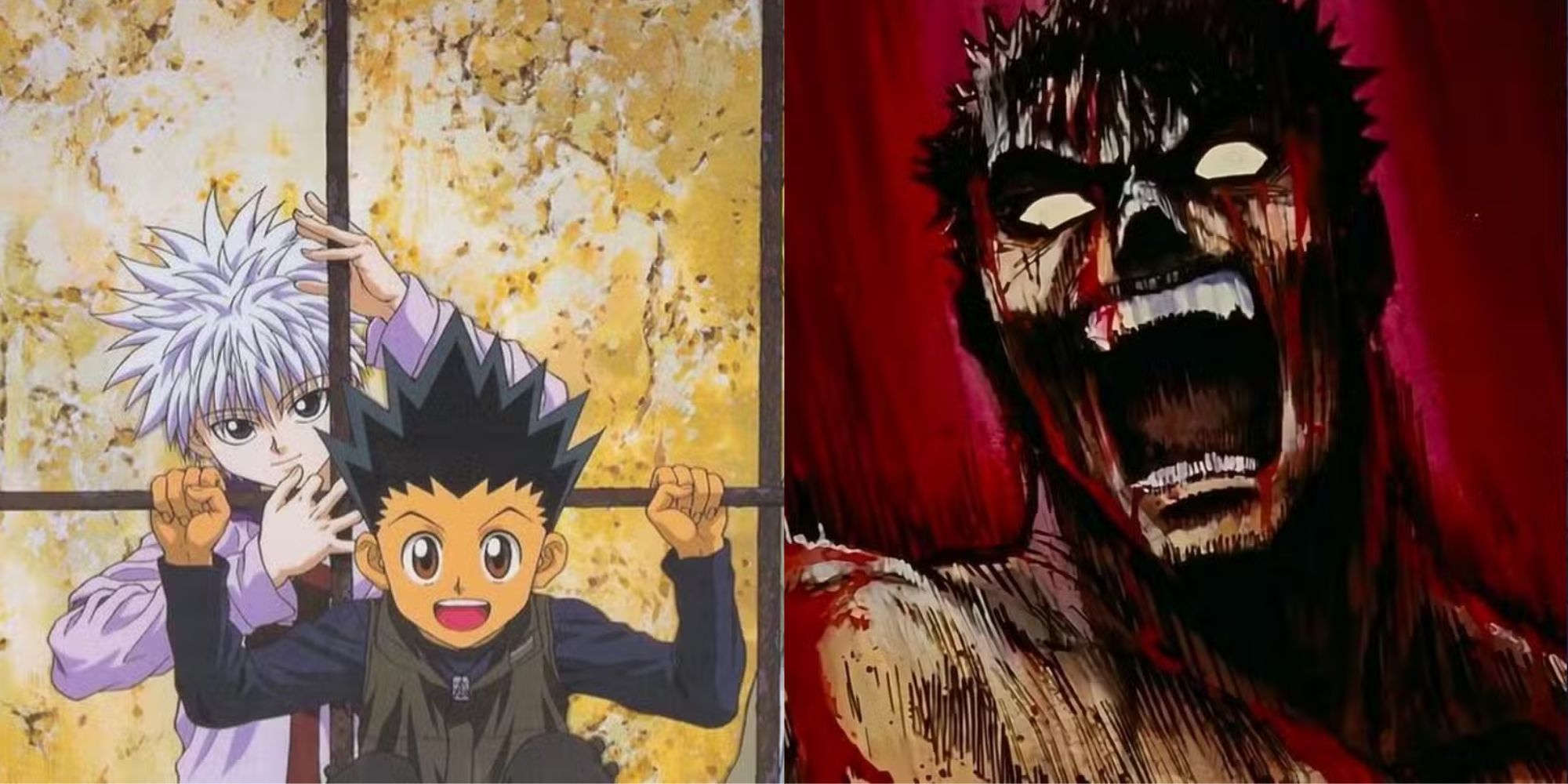
While most fans now associate Hunter x Hunter with the 2011 Madhouse adaptation, it all began with the 1999 version produced by Nippon Animation. Covering the Hunter Exam, Heaven’s Arena, and Yorknew City arcs, the series took a darker tone as it progressed, foreshadowing the brutal emotional weight of the manga.
Yoshihiro Togashi, already well-known for Yu Yu Hakusho, crafted a story that challenged the tropes of shonen anime. Gon was a happy-go-lucky protagonist on the surface, but the 1999 series didn’t shy away from showing how obsessive and even cruel he could be when driven.
The Yorknew City arc was the anime’s crown jewel. Kurapika’s descent into revenge against the Phantom Troupe brought a level of maturity rarely seen in anime at the time.
Although the anime was never completed due to Togashi’s frequent health-related absences, it still retains a unique charm. The original dub was never officially licensed for English-speaking audiences until much later, making it a somewhat cult favorite among early 2000s anime fans.
6
Rurouni Kenshin
Wandering Swordsman With A Bloodstained Past

Set in the early Meiji era, Rurouni Kenshin followed the story of Himura Kenshin, a former assassin known as Battousai, who swore never to kill again. The anime aired from 1996 to 1998, and adapted Nobuhiro Watsuki’s manga into an emotional tale about redemption, identity, and how a violent man can seek peace.
Kenshin’s struggle wasn’t just internal. His past kept catching up with him, in the form of deadly enemies who remembered his deeds from the Bakumatsu era. The Kyoto Arc, centered on his battle with Shishio Makoto, is still widely considered one of the best anime arcs of the ’90s.

Related
10 Best Anime Shows For Kids
Looking for quality screen time for your little ones? Here are 10 kids anime series that blend colorful adventure with meaningful lessons.
The anime also balanced serious themes with a slice-of-life tone, showing Kenshin’s interactions with Kaoru, Yahiko, and Sanosuke. These lighter moments made the darker ones hit even harder.
A dub by Media Blasters aired in the early 2000s, helping the anime become a gateway show for Western fans. Later OVAs like Trust & Betrayal peeled back the curtain on Kenshin’s brutal past in even greater detail.
5
Berserk
Darkness Beyond the Eclipse


Few anime from the 20th century left as disturbing an impact as the 1997 adaptation of Berserk. Directed by Naohito Takahashi and produced by OLM, this version covered the Golden Age Arc, the rise and fall of the Band of the Hawk, and the shattering of Guts’ life at the Eclipse.
Kentaro Miura’s manga was notorious for its extreme violence and emotional depth. The anime toned down the gore but preserved the emotional intensity. Guts and Griffith’s twisted friendship, Casca’s tragic fate, and the haunting inevitability of betrayal all made this short 25-episode run unforgettable.
The series ended abruptly at the Eclipse, with no continuation in sight for years. For many fans, it was their first experience with an anime that didn’t offer a clear ending.
Miura passed away in 2021, but his influence, and the nightmare he created, still echo. The English dub aired via Media Blasters, and while the animation shows its age, the storytelling remains as devastating as ever.
4
Initial D
Racing Through the Mountain Passes


Initial D
- Release Date
-
1998 – 2014
- Network
-
Fuji TV, ANIMAX
- Directors
-
Hiroshi Kimura, Osamu Sekita, Taiki Nishimura, Yukihiro Shino, Shu Watanabe, Hiroshi Kotaki, Mihiro Yamaguchi, Taiji Kawanishi, Ken Baba, Akira Shimizu, Satoshi Nakagawa, Yukio Nishimoto, Yuichiro Miyake, Yasuo Ejima, Masayuki Matsumoto
Initial D is more than a racing anime, it’s a cultural time capsule. First airing in 1998, it chronicled Takumi Fujiwara’s evolution from a tofu delivery driver to a downhill street racing legend on Mount Akina. His weapon of choice? A humble Toyota AE86, now iconic thanks to this show.
Adapted from Shuichi Shigeno’s manga, Initial D was among the first anime to combine 2D animation with 3D CGI for its race scenes. While clunky by today’s standards, the CGI allowed for dynamic shots of tight corners, drifting physics, and impossible overtakings set to pulsing Eurobeat tracks.
The anime had multiple seasons, labeled as Stages, starting with First Stage in 1998. Each stage pushed Takumi and his skills further, while also exploring rivalries, relationships, and personal growth.
Tokyopop released its English dub with a controversial Americanized script, but later dubs restored much of the original dialogue. For fans of cars, it’s one of the most faithful portrayals of racing ever animated.
3
Yu Yu Hakusho
Before Spirit Guns, He Was Just A Delinquent With A Death Wish

Yusuke Urameshi was just another troublemaking teen until he died saving a child. That’s how Yu Yu Hakusho started, and it only got more intense from there. Airing from 1992 to 1995, it was one of the defining supernatural shonen anime of the 90s.
Created by Yoshihiro Togashi, the anime split itself into distinct sagas: Spirit Detective, Dark Tournament, Chapter Black, and Three Kings. Each arc had its own tone and set of stakes, with the Dark Tournament remaining a fan-favorite for its brutal, nonstop combat and team dynamics.
Characters like Hiei and Kurama became cult icons. Kuwabara’s hot-blooded loyalty contrasted perfectly with Yusuke’s cynicism. And the villains, from Toguro to Sensui, were complex, each one forcing Yusuke to confront something different about power and morality.
Funimation’s English dub was a hit, especially thanks to Justin Cook’s performance as Yusuke. The series cemented itself as a cornerstone of Toonami’s golden era.
2
Detective Conan
The Case That Never Ends

Since 1996, Detective Conan, or Case Closed, as it’s known overseas, has told the story of teenage prodigy Shinichi Kudo, who is turned into a child after being poisoned. Trapped in the body of a kid, he continues solving crimes under the alias Conan Edogawa.
Gosho Aoyama’s manga and anime combined episodic murder mysteries with an overarching plot involving the sinister Black Organization. The series mixed Agatha Christie-style deductions with modern-day espionage and criminal conspiracy.
Even in its early seasons, Conan’s cases were more intricate than most anime dared to attempt. Viewers were invited to solve them alongside him, using clues peppered throughout the episodes.
The anime has over 1000 episodes now, but its foundation was built in the 1990s. The early Funimation dub only covered part of the series, and licensing issues kept the rest out of reach for many English-speaking fans for years. Still, its legacy as a brainy alternative to battle shonen remains intact.
1
Dragon Ball
The Journey That Started It All


Dragon Ball
- Release Date
-
1986 – 1989
- Directors
-
Minoru Okazaki, Daisuke Nishio
- Writers
-
Akira Toriyama
When Dragon Ball debuted in 1986, nobody knew it would change anime forever. Inspired loosely by Journey to the West, Akira Toriyama’s original series began as a comedy-adventure following a monkey-tailed boy named Goku. But it evolved into something much bigger.
The original anime introduced staples that shonen anime still follow: martial arts tournaments, power levels, transformations, and endless rivalries. Goku’s journey from naïve child to world-saving fighter became the blueprint for generations of heroes.
Later seasons (Dragon Ball Z) would launch the series into global superstardom, but Dragon Ball laid the groundwork. It introduced characters like Bulma, Master Roshi, Krillin, and even Piccolo in his original villainous form.
Its dubbed version aired in multiple regions, Ocean dub in Canada, Funimation in the U.S., with a huge impact on Saturday morning TV. For many, Dragon Ball wasn’t just an anime. It was their childhood.

Next
10 Best Action Anime Series To Watch On Crunchyroll
Here are Crunchyroll’s top action animes that deliver intense battles, deep characters, and epic stories.

